
Bale Collision Center has released consumer guidance explaining how collision damage to a hood, trunk lid, or liftgate is evaluated differently from ordinary cosmetic panel damage. The new publication focuses on closure panels, movable exterior components whose condition depends not only on surface appearance but also on how they align, latch, seal, and interact with surrounding vehicle components.
The guidance supplements Bale Collision Center’s auto body repair information by addressing a specific distinction in collision repair: a closure panel can have limited visible damage while the accident has also changed its fit or operation.
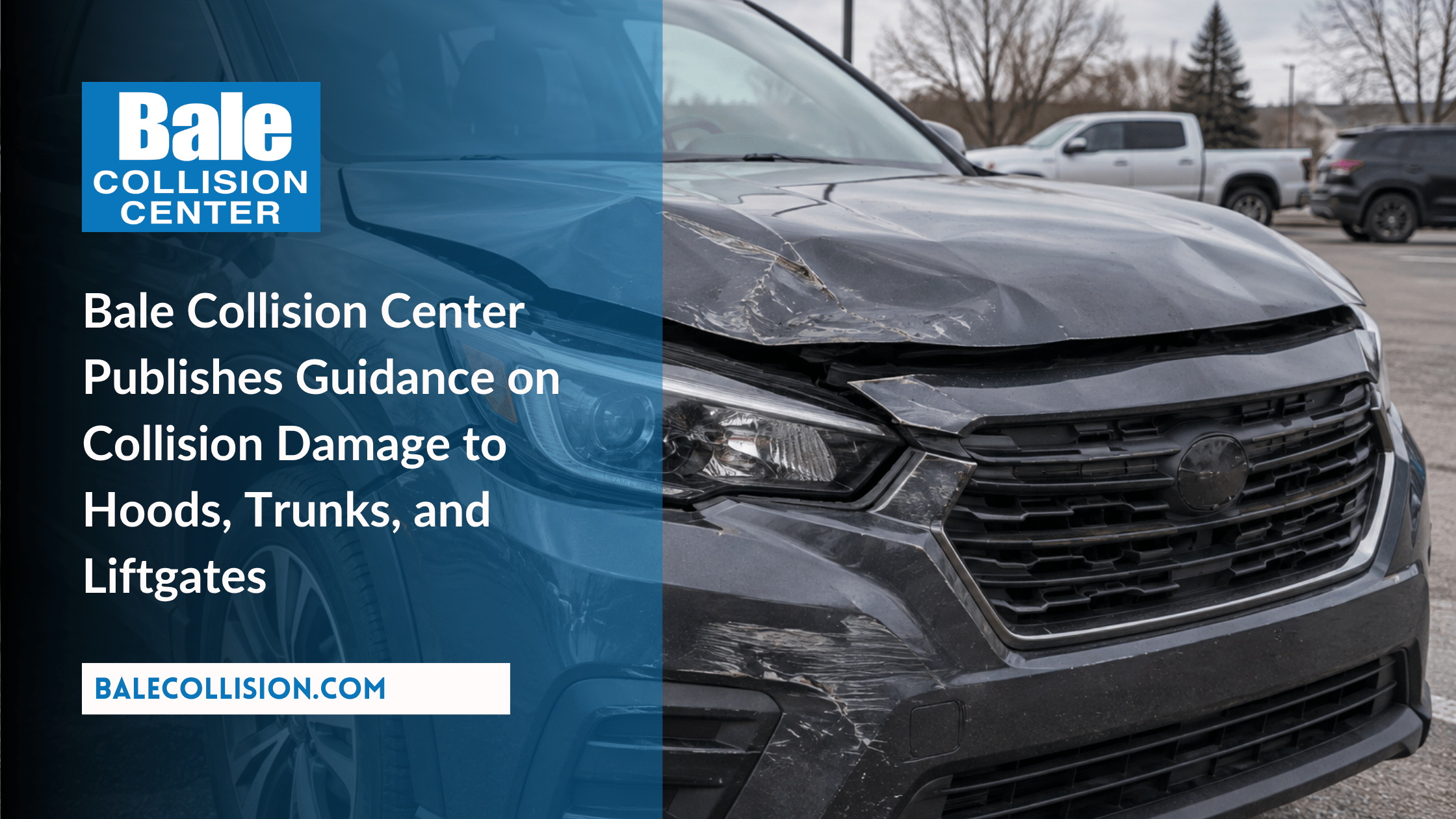
Hoods, trunk lids, and liftgates rely on hinges, latches, mounting locations, and adjoining body openings. Following a collision, technicians can compare the visible panel damage with how the component opens, closes, and sits relative to surrounding panels.
A hood that sits unevenly between the fenders, for example, may require evaluation of the hood, hinges, latch, and associated mounting areas. Rear impacts can produce similar changes around a trunk lid or liftgate. The purpose of this evaluation is to identify the source of the changed fit rather than assume that the exterior panel itself is the only component involved.
Repairability is considered separately from appearance. The location and characteristics of the damage, the panel material, and applicable vehicle-specific repair information can influence whether repair or replacement is appropriate. Damage near an edge, hinge, latch, reinforcement, or attachment area can present different repair considerations from a localized condition elsewhere on the panel.
Bale Collision Center’s collision repair information provides additional context about evaluating documented accident damage and incorporating applicable repair procedures into the repair plan.
The new guidance gives particular attention to liftgates and other closure panels containing integrated equipment. Depending on the vehicle, a liftgate can incorporate rear glass, wiring, lighting, a rearview camera, switches, a wiper, power-opening components, and other equipment.
When collision damage involves one of these assemblies, technicians can identify which equipment is installed and determine which components are relevant to the repair. A power liftgate that no longer operates normally, for example, presents a different set of considerations from a manually operated trunk lid with localized exterior damage.
Rearview cameras illustrate why vehicle configuration matters. Cameras can be mounted within a liftgate, trunk lid, handle area, or related component. If collision repair involves that location, the repair plan can account for the camera, mounting arrangement, wiring, and any applicable vehicle-specific procedures.
This does not establish that every repair involving a camera requires the same diagnostic or calibration operation. Those requirements depend on the vehicle, installed equipment, affected components, and work performed.
Sealing is another functional consideration addressed in the publication. Trunk and liftgate openings use weatherstripping and mating surfaces to manage water around the cargo area. When a rear impact changes panel position or damages an opening, technicians can evaluate the relationship between the closure and its sealing surfaces.
The September guidance also explains why surrounding collision damage matters. A hood does not function independently of the fenders, front body areas, latch mounting location, and other adjoining components. Similarly, a trunk lid or liftgate operates within a rear body opening bordered by components that may also have been involved in the impact.
Vehicle-specific repair procedures can provide direction when technicians evaluate these areas. Depending on the vehicle and component, manufacturer information may address inspection, repair limitations, replacement, installation, adjustment, or other operations. The documented condition of the vehicle determines which procedures are relevant to the repair.
This closure-panel focus is what distinguishes the September publication from broader collision repair information. Rather than presenting hoods, trunks, and liftgates as ordinary exterior panels, the guidance explains how three characteristics work together after an accident: the physical condition of the panel, its ability to operate within the body opening, and the condition of equipment and adjoining components involved in the same impact.
For vehicle owners, changes in operation can provide useful information after a collision. A hood, trunk, or liftgate that suddenly requires unusual effort to close, no longer aligns with surrounding panels, develops sealing concerns, or shows changes in power-operated functions can be documented for evaluation.
A hood or other closure that does not latch securely should be evaluated before normal vehicle use rather than repeatedly forced into position.
Information about Bale Collision Center’s facility is available through its Downtown Little Rock location resource.
The September 17 publication provides consumers with a focused explanation of why closure-panel collision repair can extend beyond correcting a visible dent. Evaluating physical damage together with operation, installed equipment, and the surrounding impact area allows the repair plan to reflect the documented condition of the individual vehicle.
Bale Collision Center is a family-owned collision repair business that has served the Little Rock community since 1952. The company provides collision repair, auto body repair, paintless dent repair, automotive refinishing, glass replacement, ADAS services, and related collision repair services through its two Little Rock locations. Its Downtown facility is located at 100 N Cross St, Little Rock, AR 72201.
###
For more information about Bale Collision Center, contact the company here:
Bale Collision Center (Downtown)
Jason Spiller
(501) 375-0910
jspiller@baleautomotive.com
100 N Cross St, Little Rock, AR 72201, United States