Sheridan, United States, July 14, 2026 (GLOBE NEWSWIRE) -- EVIQO, a leading brand of UL- and Energy Star-certified Level 2 home EV chargers in the US and a 2026 Red Dot Design Award winner, has released consumer guidance on what charging an electric vehicle at home actually costs in 2026 — and which incentives still apply now that the federal Section 30C charger credit has expired.
The guidance lands at a moment when the math matters more than usual. The federal charger tax credit ended for installations placed in service after June 30, 2026, regular gasoline sits near $3.80 per gallon (AAA), and residential electricity averages 18.8 cents per kilowatt-hour (EIA, April 2026).
One of the biggest misconceptions is that charging at home costs about the same as filling up at the pump. At today's national average rates, an efficient EV runs on roughly 5 to 6 cents per mile when charged at home. A 30-mpg gas car costs more than double that. The idea that gas and home charging are comparable does not hold up once you run the numbers.
The core numbers: 5 to 6 cents per mile
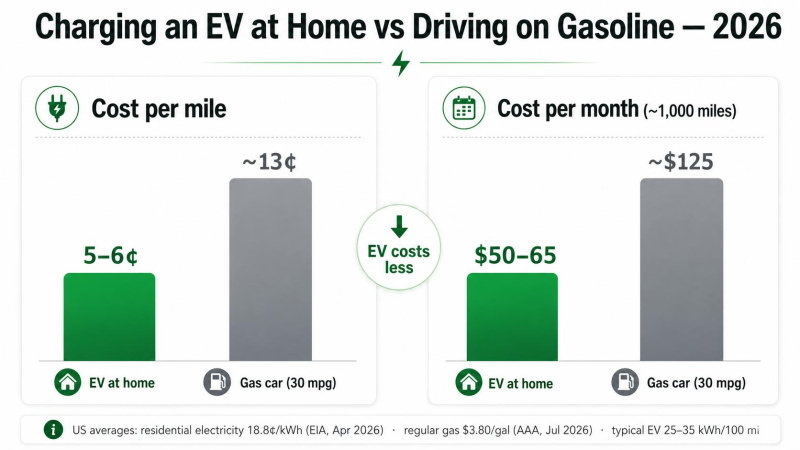
According to EVIQO's guidance, the arithmetic is straightforward. Most EVs use 25 to 35 kWh to travel 100 miles. At the US average residential rate of about 19 cents per kWh, that works out to roughly 5 to 6 cents per mile. A conventional car getting 30 mpg at $3.80 a gallon costs nearly 13 cents per mile, around two and a half times more.
The formula for any household: (kWh per 100 miles ÷ 100) × client's electricity rate. In low-cost states at 13 cents the per-mile figure drops further; in high-cost markets like California or New England at 30 cents it rises, but still undercuts gasoline.
| Battery size | At 13¢/kWh | At 19¢/kWh (US avg) | At 30¢/kWh |
| 60 kWh (compact EV) | ~$7.80 | ~$11.40 | ~$18.00 |
| 75 kWh (midsize EV) | ~$9.75 | ~$14.25 | ~$22.50 |
| 100 kWh (truck / large SUV) | ~$13.00 | ~$19.00 | ~$30.00 |
The monthly picture
The average American drives about 1,000 miles a month (FHWA). On home electricity, that comes to roughly $50 to $65 for most EVs, compared with roughly $125 in gasoline for the same distance. Over a five-year ownership window, the fuel-cost gap alone reaches several thousand dollars.
Home versus public charging
Where charging happens matters as much as what car is charged. Home electricity averages about 19 cents per kWh, while AAA puts the national public-charging average at about 41 cents, with peak-hour DC fast rates running higher still.
| Where you charge | Typical rate | 75 kWh full charge | Best for |
| Home (Level 2) | ~19¢/kWh | ~$14 | Daily charging — cheapest |
| Public DC fast | ~40–50¢/kWh | ~$30–$38 | Road trips only |
What changed on June 30 — and what still pays
The federal Section 30C credit, 30% of charger and installation costs up to $1,000, expired for chargers placed in service after June 30, 2026, under the One Big Beautiful Bill Act. Households that installed before the deadline can still claim it on IRS Form 8911 with their 2026 return.
The federal tax credit may be gone for new installations, but the layer of incentives beneath it is still very much active. Utility rebates commonly range from a few hundred dollars to $1,000 or more per charger, and off-peak charging schedules keep lowering costs every night. That is usually the first place worth pointing buyers.
Live 2026 programs bear that out. ComEd in Illinois pays $1,000 toward a residential Level 2 installation, and up to $2,500 for qualifying customers, for chargers installed through December 31, 2026, with enrollment in a time-of-use rate required. LADWP in Los Angeles rebates up to $1,000 on a qualified home charger, and Michigan's Consumers Energy pays up to $500, rising to $1,000 for income-qualified households. Most programs are first-come, first-served and change during the year, so EVIQO advises confirming the current offer for a specific address before purchasing.
The off-peak arithmetic is just as concrete. A driver covering 1,000 miles a month uses roughly 300 kWh. Shifting that load to an overnight rate five to seven cents below the standard price saves $15 to $20 a month, roughly $900 to $1,200 over five years, on par with or above the $1,000 ceiling the expired federal credit ever paid out.
EVIQO's six-point checklist for home charging in 2026:
- Buy certified. A UL- or ETL-listed, Energy Star-certified Level 2 unit is the most common eligibility requirement across remaining rebate programs.
- Check your ZIP before you buy. Incentives change often; confirm the current offer for your exact address.
- Switch to a time-of-use plan. Overnight rates can run half the daytime price.
- Schedule charging off-peak. A smart charger with a subscription-free app shifts every session into the cheap window automatically, and per-session tracking shows the saving on your phone.
- Match amperage to the car and the panel. A 40A plug-in unit on a standard NEMA 14-50 outlet covers most daily driving; 48A hardwired suits big-battery trucks and multi-EV homes. Certified 40A units now start just under $400.
- Installing outdoors? Check the enclosure rating. An IP66 / NEMA 4 weatherproof housing stands up to rain, snow, heat and dust.
About EVIQO
EVIQO is a leading brand of Level 2 home EV chargers in the US and a 2026 Red Dot Design Award winner. Its chargers are UL, ETL, FCC and Energy Star certified, built into an IP66 / NEMA 4 weatherproof enclosure with steel mainboard shielding, and available as a 40A plug-in (NEMA 14-50) or 48A hardwired unit (adjustable up to 50A) in both J1772 and NACS versions. A subscription-free app adds off-peak scheduling, adjustable amperage, per-session cost tracking and over-the-air updates. Prices start just under $400. More information is available on the EVIQO website.
Attachment

EVIQO
web@eviqo.io