HongKong, June 24, 2026 (GLOBE NEWSWIRE) -- Hi3D is celebrating its first anniversary with a limited-time promotional campaign that includes discounted subscription plans, creator competitions, community events, and early access opportunities for upcoming platform features. The campaign highlights how the AI 3D maker platform has evolved over the past year from a model-generation tool into a broader workflow for creating print-ready 3D objects.
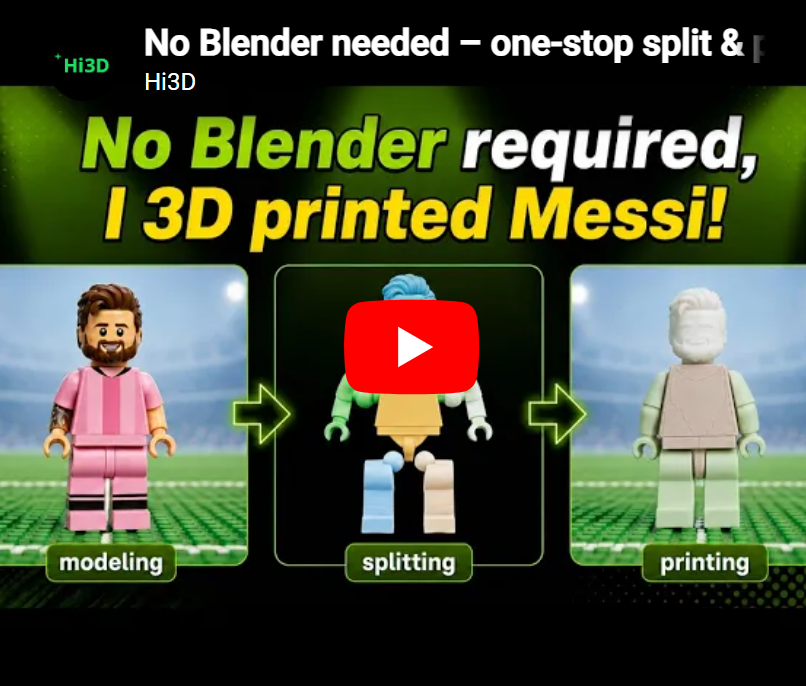
https://www.youtube.com/watch?v=BhdXKr7oswE
As part of the anniversary push, Hi3D is showcasing one of its most accessible use cases: turning a single football photo into a custom LEGO-style collectible figure using AI and a consumer 3D printer. With the 2026 FIFA World Cup approaching, the company is positioning the feature as a new way for football fans to create personalized memorabilia beyond jerseys, posters, and traditional licensed merchandise.
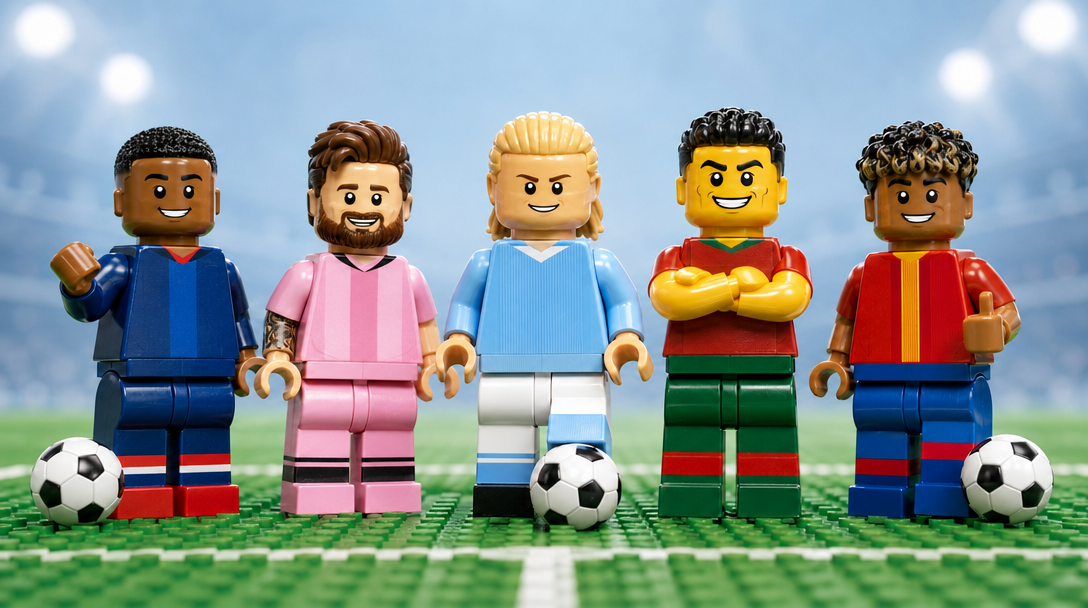
Until recently, creating a personalized football figurine required either purchasing expensive licensed merchandise or learning professional 3D modeling tools such as Blender. Both options come with obvious limitations. Official products are often costly and offer little customization, while creating a model from scratch can take days of work and significant technical knowledge.
Hi3D is trying to change that.
Positioned as an All-in-One AI 3D Maker Platform, Hi3D combines AI image generation, AI 3D modeling, model repair, automatic part splitting, articulation generation, print preparation, and slicer integration into a single workflow. Instead of spending hours moving files between different software packages, users can generate a printable model in just a few clicks.
To see how practical this workflow really is, we decided to create a LEGO-style Messi figure from start to finish and test the entire process ourselves.
Difficulty: Beginner-friendly
Hands-on Time: About 5 minutes (the printer does the rest)
Cost: One Hi3D account + roughly $4 in filame
What You'll Need
Before getting started, prepare the following:
- A Hi3D account (new users receive free credits, and anniversary promotions currently provide additional discounts and usage allowances)
- A reference image of Messi
- A multicolor FDM 3D printer
- Several common filament colors such as green, white, black, and skin tone
- About 70 grams of material
For our test, we used a Bambu Lab H2D printer with an AMS multicolor system. However, Hi3D also supports workflows that connect directly with Bambu Studio, OrcaSlicer, Creality Print, and Elegoo Slicer.
An additional advantage is that users with single-color printers are not excluded. Hi3D can export monochrome printable models as well, creating a statue-like collectible rather than a multicolor figure.
Step 1: Generate a LEGO-Style Messi and Convert It Into 3D
The first step begins inside a web browser.
Using Hi3D's built-in AI image tools, we uploaded a photograph of Messi and entered a simple prompt asking the system to transform the image into a LEGO-style character.
Hi3D integrates several leading image-generation technologies, allowing users to perform style transfers, character redesigns, and image creation without leaving the platform. Within seconds, the AI produced a stylized version of Messi complete with recognizable facial features, hairstyle, and football uniform details.
Most AI image tools would stop there.
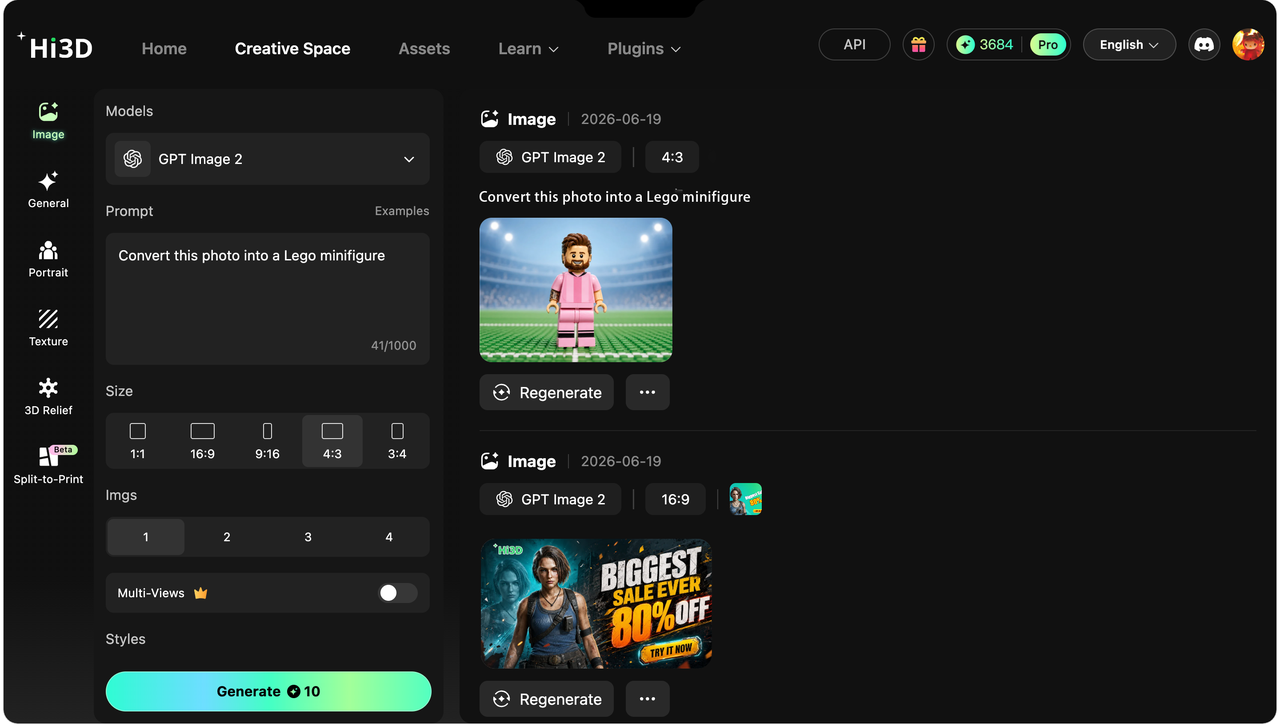
Hi3D takes the next step by converting the generated image directly into a three-dimensional model. The system automatically reconstructs major body structures, including the head, torso, arms, and legs, while preserving the visual style established in the image-generation stage.
The result is a printable 3D character rather than a flat illustration.
Step 2: Automatically Create Articulated Parts
This is where Hi3D starts to distinguish itself from traditional AI 3D generators.
Generating a model is only one part of the challenge. For hobbyists who actually want to manufacture a figure, the model also needs to be printable, assemblable, and durable.
Hi3D includes automated part-splitting technology designed specifically for physical production. The system analyzes the geometry of the character and identifies logical separation points for different body regions.
Using its built-in character templates, Hi3D can automatically divide a figure into components such as the head, torso, arms, legs, accessories, and base.
Users can then choose between fixed assembly structures or articulated connections.
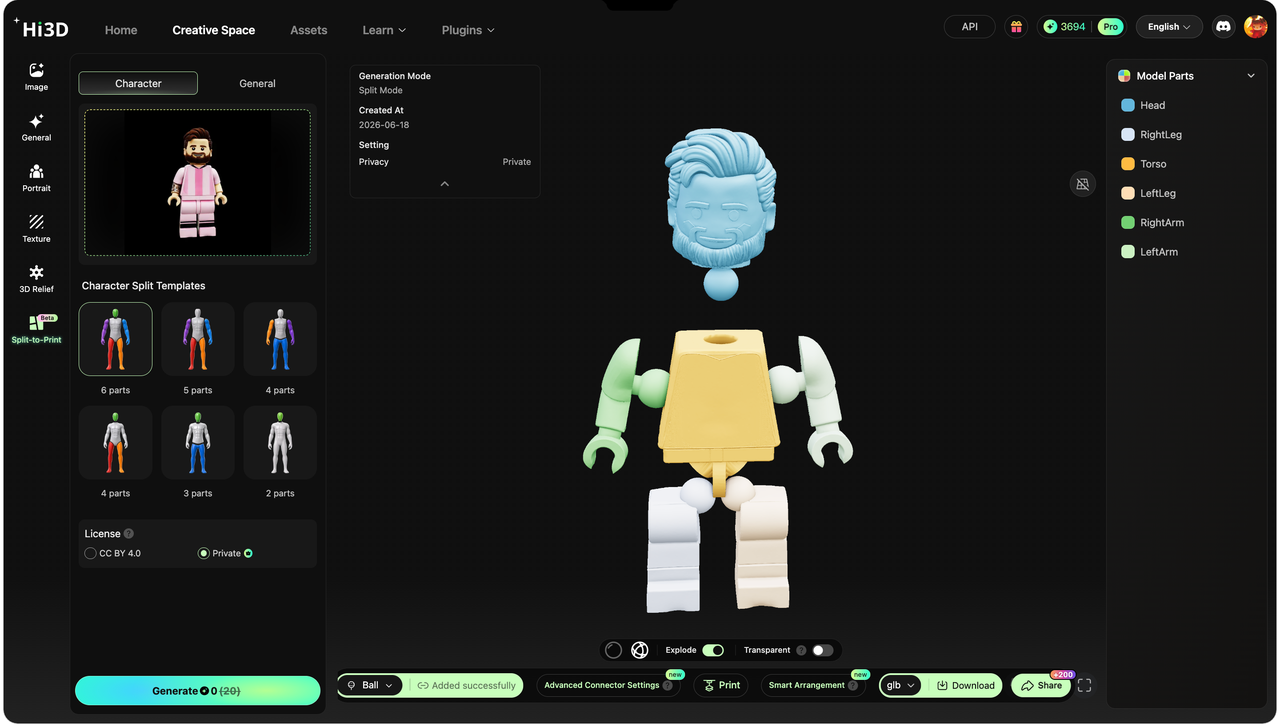
For this project, we selected spherical ball joints to create a fully poseable figure. Hi3D automatically generated the required connection structures while calculating assembly tolerances to ensure proper fit after printing.
The result was a LEGO-style Messi capable of moving its head, arms, and legs rather than a static decorative object.
Traditionally, creating these joints would require significant CAD experience and repeated test prints. Hi3D completes the process in minutes.
Step 3: Optimize the Layout and Send Directly to the Slicer
Many makers know that creating a model is only half the battle.
A poorly oriented print can lead to excessive support material, surface defects, failed prints, or long production times. Traditionally, users spend considerable time inside slicers adjusting part orientation, support placement, spacing, and print parameters.
Hi3D addresses this through its intelligent print-preparation workflow.
The platform automatically evaluates model geometry and applies orientation strategies designed to improve print quality and manufacturing efficiency.
For example, full-body characters are slightly tilted to hide support marks in less visible areas, while elongated objects such as swords are angled to minimize support structures along sharp edges.
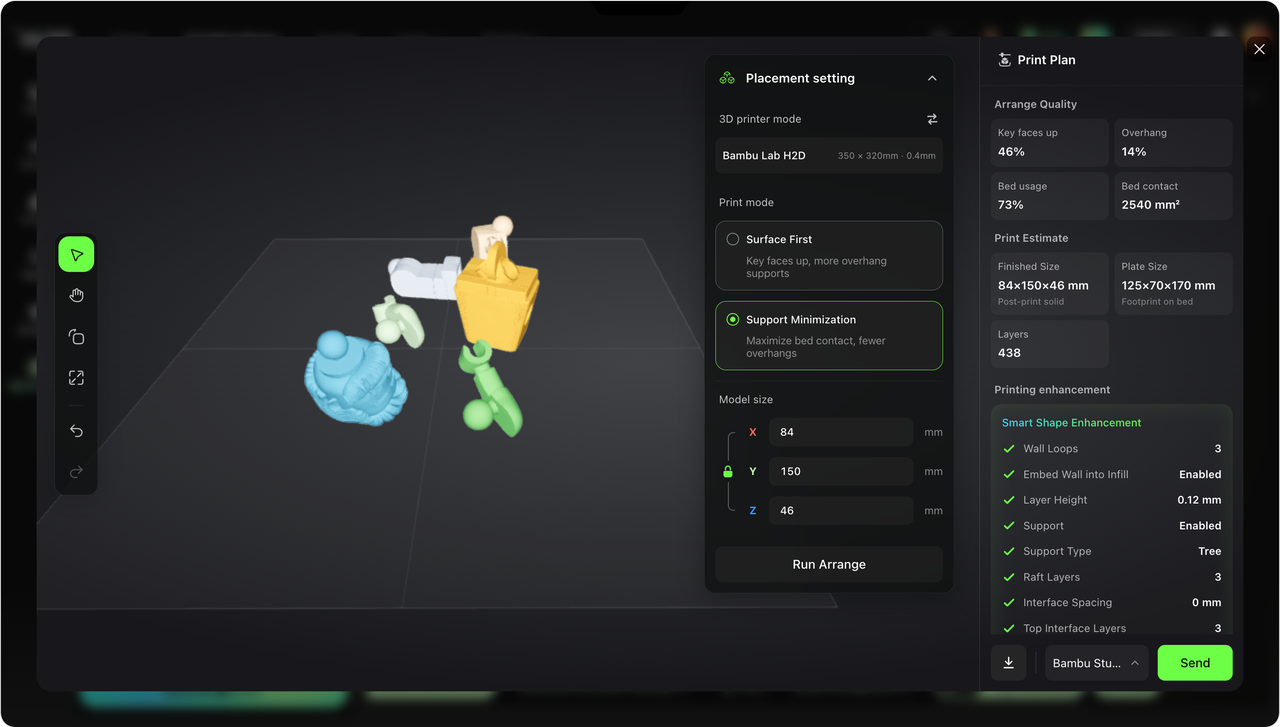
Users can choose between two optimization modes:
- Surface Quality Mode, which prioritizes visual appearance and assembly accuracy
- Support Reduction Mode, which minimizes material consumption and print time
Once optimization is complete, the model can be exported directly to Bambu Studio or other supported slicers.
Rather than transferring only an STL file, Hi3D packages the project as an enhanced 3MF file containing layout information, color assignments, print settings, and support configurations.
When we opened the project inside Bambu Studio, everything was already configured and ready for printing.
Step 4: Print and Assemble
After sending the project to the printer, the remaining work is handled by the machine.
Our multicolor print required approximately eight hours to complete.
When finished, the build plate contained several cleanly printed components:
- A multicolor torso
- A detailed Messi head
- Separate arms and legs
- Football boots and accessory elements
Because the joints and tolerances had already been optimized during the generation process, assembly was surprisingly straightforward.
No sanding was required.
No redesign was necessary.
No glue was needed.
The ball-joint components snapped together smoothly, creating a finished figure that could be posed in a variety of football-inspired celebrations.
What started as a single image had become a tangible collectible.
Beyond Football Figures: What Makers Are Creating
The Messi project highlights a broader trend within the maker community.
As AI-generated models become easier to create, the biggest challenge is no longer generating geometry—it is turning digital assets into physical products.
Hi3D's approach focuses on bridging that gap.
By automating tasks such as model repair, watertight conversion, part splitting, articulation generation, color optimization, print orientation, and slicer preparation, the platform allows creators to spend more time designing and less time troubleshooting.
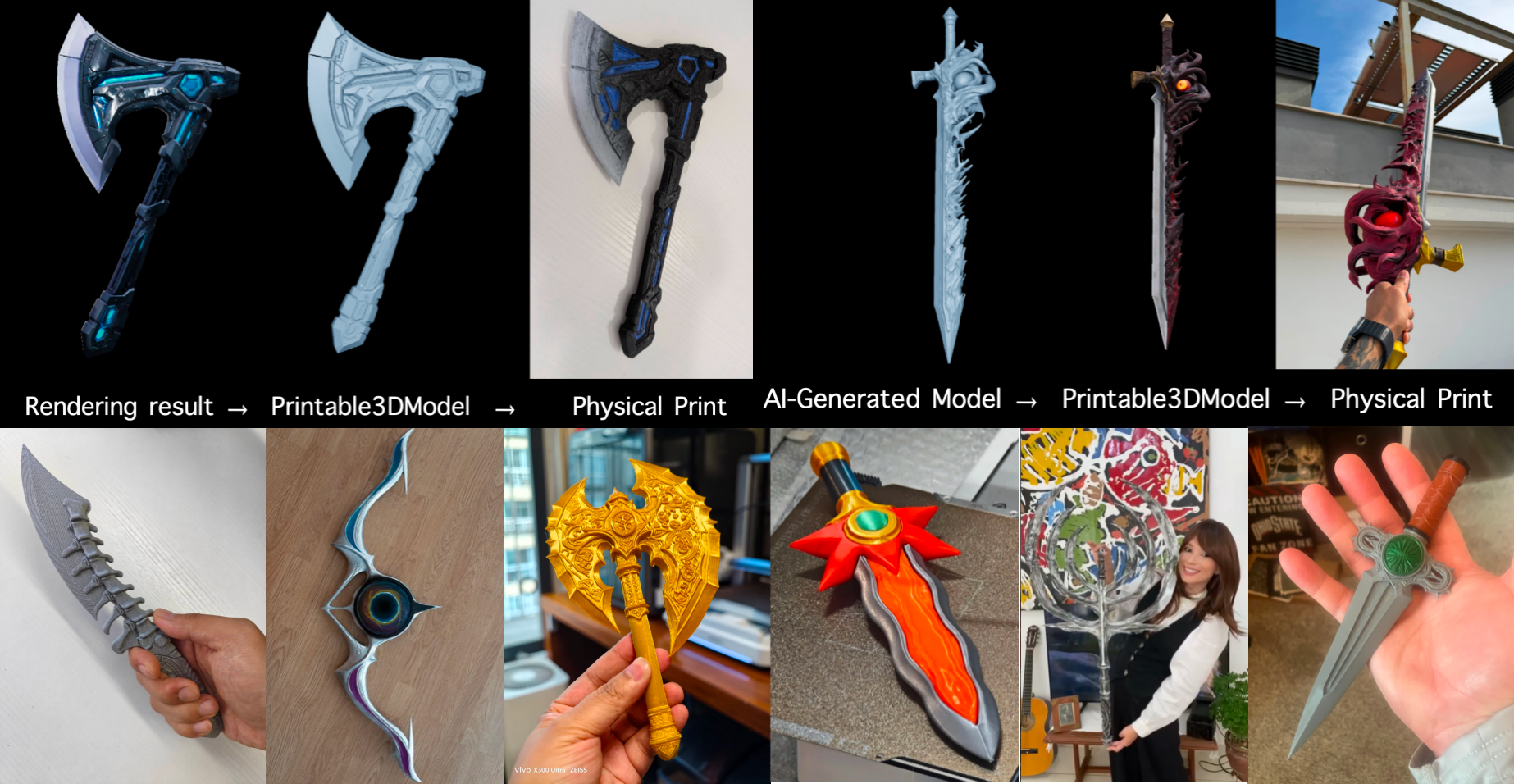
The results can already be seen in projects created by Hi3D users around the world. Community challenges have produced everything from fantasy weapons and collectible statues to articulated toys and custom display pieces.
Many of these projects would traditionally require multiple software packages and advanced technical skills. With AI-assisted manufacturing workflows, they become accessible to a much wider audience.
Making 3D Creation More Accessible
Different users benefit from Hi3D in different ways.
Collectors and figure enthusiasts gain access to automated articulation, assembly-ready parts, and printable character models. Multicolor printing users can take advantage of AI-driven color separation and optimized material usage. Print farms and maker spaces benefit from automated repair tools and faster preparation workflows. Complete beginners can simply upload a photo and generate customized figurines, pet models, refrigerator magnets, and personalized gifts without learning professional 3D software.
In many ways, Hi3D represents a shift in the AI 3D industry—from focusing solely on model generation toward enabling real-world manufacturing.
About Hi3D and the Anniversary Event
Hi3D is an All-in-One AI 3D Maker Platform built to connect AI-powered creativity with physical manufacturing. Its feature set spans text-to-3D generation, image-to-3D conversion, automatic mesh repair, intelligent character segmentation, ball-joint generation, smart print layout optimization, and one-click 3MF export for major slicing ecosystems.
The company is currently celebrating its first anniversary with a limited-time promotional campaign featuring discounted subscription plans, creator competitions, community events, and early access opportunities for upcoming platform features.
Whether you're interested in building a custom football collectible, designing original figures, or creating your first 3D-printed project, Hi3D aims to make the path from idea to object dramatically easier.
New users can receive 300 free Hi3D credits through the link below and experience the complete AI-to-3D-print workflow for themselves—from concept generation to printable 3MF files.
Get started here:Hi3D.ai

Irina Cai
contact@email.hitem3d.ai