Phantom Neuro Implants Neural Interface in Humans for the First Time
PR Newswire
AUSTIN, Texas, Oct. 20, 2026
Phantom X is designed to translate intended arm and hand movements into commands for robotic prosthetic limbs
AUSTIN, Texas, Oct. 20, 2026 /PRNewswire/ -- Phantom Neuro today announced that the first participants with upper limb loss in its CYBORG early feasibility study have undergone implantation of Phantom X, a device placed under the skin in one's residual limb, turning muscle signals into wireless commands for a prosthetic limb. The procedures were performed at Cabrini Health in Melbourne, Australia.
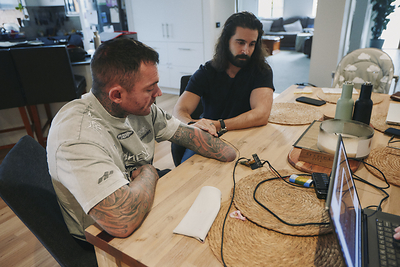
The implantations mark the first time Phantom Neuro's sensor has been implanted in human participants. The initial participants were implanted during outpatient procedures lasting roughly an hour each, without the use of general anesthesia, providing a strong signal for the simplicity and safety of Phantom X implantation. CYBORG is an ongoing study evaluating the safety, performance and usability of Phantom X in people with upper-limb loss.
"Most people who have lost their limbs still have the ability to control their limbs, down to the individual fingers, in their mind's eye. This is what is colloquially known as a phantom limb - the remaining perception of one's limb when it is no longer physically there. Our goal is to capture signals associated with intended movements of that phantom limb and translate them into actual movements of a robotic limb," said Dr. Connor Glass, founder and CEO of Phantom Neuro. "Our goal goes beyond recreating limb function. It is doing so in a safe and cost-effective way, with an experience that looks more like a cosmetic procedure than it does neurosurgery. This is a significant step towards achieving that goal."
Phantom X uses a sensor device placed beneath the skin, over the muscles in the residual limb. When a person attempts to move their missing fingers and wrist, those remaining muscles generate electrical signals. The system detects and interprets those signals, ultimately translating them into commands for a compatible prosthetic device. By doing so, a person controls robotic limbs in the exact same manner as intact limbs.
Dr. Michael Lo, a renowned Plastic and Reconstructive Surgeon, performed the procedures at Cabrini Health. Prosthetic care, occupational therapy, and testing are provided by ProMotion Prosthetics and Enable Rehab.
"This study is an opportunity to evaluate everything from the surgical procedure to the technology itself and how these innovations can impact participants' lives over time," said Dr. Lo. "What excites me most about this technology is the scale of impact that is possible due to the relative simplicity of the surgical procedure. Great technology that is safe and easy to implement can impact a lot of people's lives."
The implantations are an early clinical milestone. The study is ongoing, and conclusions about the implanted system's safety, effectiveness, and ability to improve prosthetic control will depend on further evaluation. Phantom X is investigational and is not approved for commercial use.
About Phantom Neuro
Phantom Neuro is a human-machine interface company developing minimally invasive neural interfaces that enable intuitive control of prosthetic limbs, exoskeletons and future robotic systems. By translating natural neuromuscular signals into digital commands, Phantom Neuro is building technology designed to restore mobility while making advanced human-machine interfaces more scalable and accessible than traditional brain-computer interfaces.
Media Contact
press@phantomneuro.com

 View original content to download multimedia:https://www.prnewswire.com/news-releases/phantom-neuro-implants-neural-interface-in-humans-for-the-first-time-302912256.html
SOURCE Phantom Neuro Inc.