Rice breaks ground on the Arc in the Ion District, expanding Houston's innovation ecosystem
PR Newswire
HOUSTON, Nov. 5, 2026
Nearly 200,000-square-foot research hub will connect Rice, industry and entrepreneurs to accelerate discovery, collaboration and commercialization
HOUSTON, Nov. 5, 2026 /PRNewswire/ -- Rice University broke ground on the Arc in the Ion District, a nearly 200,000-square-foot research, corporate innovation and office building designed to bring researchers, industry leaders, entrepreneurs, investors and top talent together to accelerate innovation and move ideas from discovery to real-world application.
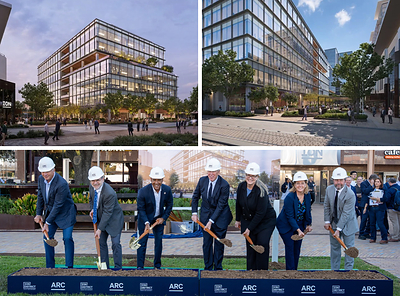
Located in Houston's Ion District powered by Rice, the Arc will feature seven floors of flexible, future-ready lab and office space for Rice and other organizations seeking proximity to leading research, highly skilled workers and Houston's dynamic innovation ecosystem. Rice will be a lead tenant, occupying nearly 80,000 square feet, or about 40% of the building.
"The Arc is a significant investment in Rice's future and in Houston's continued growth as a center for innovation," said Robert T. Ladd, chairman of the Rice Board of Trustees. "It will create new opportunities for industry leaders, researchers and students to work together on ideas with the potential for lasting impact."
The Arc will share a plaza with the Ion building, extending the 12-block Ion District and placing researchers in close proximity to companies, startups, investors and entrepreneurs.
"The Arc will bring Rice's extraordinary research and talent and Houston's impactful innovation ecosystem into even closer connection with the industries and innovators working to solve some of the world's most consequential challenges," said Rice President Reginald DesRoches. "That constant exchange of ideas and expertise will help move discoveries more rapidly from the laboratory to real-world impact."
Built for advanced research and collaboration
The facility will offer flexible lab and office environments that can adapt to evolving research and business needs. Floor plates will range from 28,000 to 31,000 square feet, with 15-foot floor-to-floor heights and infrastructure capable of supporting advanced HVAC, high-capacity electrical and emergency power systems and core laboratory requirements.
The building will also include conference and meeting spaces, an amenity lounge, fitness center, outdoor plazas, underground parking, secure bike storage and on-site retail and dining — creating opportunities to build solutions in the lab, develop partnerships across the district and connect informally throughout the day. The project is designed to meet LEED Gold criteria and will incorporate smart-building and energy-saving features.
"We are creating more than a high-performance business and research building," said Kelly Fox, Rice executive vice president for operations, finance and support. "The Arc is being designed as a destination where companies can access sophisticated infrastructure, connect with one another and build the relationships that lead to new ideas and opportunities."
Work within the building will span areas including artificial intelligence and machine learning, data science, robotics, quantum science and engineering, energy and more.
The groundbreaking event comes on the heels of the university's recent announcement of a transformational universitywide AI initiative to recruit 75 faculty members working across disciplines and expand AI-related courses and degrees. The initiative is accelerating Rice's emergence as a global leader in advanced computing and responsible AI.
"The closer researchers are to the people confronting real-world problems, the more opportunities there are to identify important questions, test ideas and improve solutions," said David Sholl, Rice executive vice president for research. "The Arc gives us an environment built specifically for that kind of sustained collaboration."
AI Foundry to call the Arc home
Rice's new AI Foundry will be located inside the Arc, where faculty AI experts will have offices and work with industry partners to tackle complex challenges, rapidly develop practical solutions and help organizations build long-term AI capabilities.
The effort will address a growing challenge: AI is advancing faster than many traditional industry innovation models can adapt. Instead of relying on lengthy, linear development cycles, the Foundry will bring Rice experts and industry partners together to identify high-value opportunities, design and test solutions, deploy them in real-world settings and continually refine them based on results.
The Foundry is envisioned to support organizations through AI readiness assessments, feasibility studies, proofs of concept, deployment-ready solutions, executive education and customized workforce training.
"The AI Foundry is exactly the kind of collaboration the Arc is designed to enable," said Amy Dittmar, the Howard R. Hughes Provost and executive vice president for academic affairs. "By bringing Rice researchers together with industry partners in a shared environment, we can accelerate the movement of ideas from research into practical applications while helping organizations build the capabilities they need to succeed as AI continues to evolve."
Responsible AI is a key catalyst in Momentous: Personalized Scale for Global Impact, Rice's strategic plan, which also calls for strategic faculty growth and specifically identifies cross-disciplinary cluster hiring as a way to build depth and breadth in areas vital to the university's future. The institution's four AI cluster areas are foundational AI; two applied areas including AI for health and AI for energy, the environment and resiliency; and responsible AI: society and ethics.
Building on the Ion's momentum
The Arc will complement the Ion building, the namesake centerpiece of Houston's innovation corridor and home to corporate and industry partners including Chevron, Microsoft, Aramco, ExxonMobil, Oxy, Shell, United, Transocean and Woodside Energy.
Co-working space in the Ion managed by Industrious is fully occupied, with more than 250 member companies. Activate, an organization that scientists and engineers become founders and move research toward commercialization, recently launched its third cohort of fellows. Twenty-five startups have participated in the program to date.
Companies based in the Ion, including Persona AI, CES Renewable, Greenflash Infrastructure and Cognite, also have experienced significant growth, reinforcing the building's role as a home for emerging companies and technology-driven organizations. The Ion's development also extends beyond offices and laboratories. MADabolic, a strength-training gym, recently opened in the building. Greentown Labs, Community Artists' Collective and Pickle Lab are also among the organizations that call the district home.
Together, the Ion and the Arc are intended to create a more connected environment where researchers, entrepreneurs, established companies and the broader Houston community can work, meet and exchange ideas.
"Houston has an extraordinary concentration of industry expertise, capital, talent and entrepreneurial energy," said Bobby Tudor, Rice alumnus and chairman of the Houston Energy Transition Initiative. "The Arc will help turn that concentration into action by creating more opportunities for breakthrough research to become technologies and companies."
The project is being developed by Rice Real Estate Co. Construction is expected to be completed in the second quarter of 2028. Preleasing opportunities are now open for companies and organizations interested in locating alongside Rice researchers and joining the broader Ion District ecosystem.
For more information, visit https://www.thearciondistrict.com/.
About Rice University
Located on a 300-acre forested campus in Houston, Texas, Rice University is consistently ranked among the nation's top 20 universities by U.S. News & World Report. Rice has highly respected schools of architecture, business, continuing studies, engineering and computing, humanities and arts, music, natural sciences and social sciences and is home to the Baker Institute for Public Policy and Kinder Institute for Urban Research. Internationally, the university maintains the Rice Global Paris Center, a hub for innovative collaboration, research and inspired teaching located in the heart of Paris, and Rice Global India in Bengaluru, India. With 4,793 undergraduates and 4,185 graduate students, Rice's undergraduate student-to-faculty ratio is just under 6-to-1. Its residential college system builds close-knit communities and lifelong friendships, just one reason why Rice is ranked in the top 10 for best quality of life by the Princeton Review.

 View original content to download multimedia:https://www.prnewswire.com/news-releases/rice-breaks-ground-on-the-arc-in-the-ion-district-expanding-houstons-innovation-ecosystem-302931374.html
SOURCE Rice University